The Brightin Star 60mm f/2.8 II 2x Macro Review: Probably the Most BudgetMacro Product on the List
The Brightin Star 60mm f/2.8 II is, dollar-for-dollar, the cheapest way to get true 2:1 magnification on a mirrorless camera in 2026 — roughly $156–$170 in the US and around £200–£265 in the UK — and despite some clear corner-cutting (no autofocus, no electronics, a de-clicked aperture ring, and brutal vignetting if you try to use it as a general-purpose lens on full-frame), the optics at macro distances are genuinely respectable. If you’re curious about going beyond 1:1 without selling a kidney for a Laowa, this is the lens to try.
Key Takeaways
- It’s the cheapest native 2x macro lens on the market. Around $156–$170 USD / ~£200–£265 GBP gets you true 2:1 magnification, all-metal build, and mounts for Sony E, Fuji X, Nikon Z, Canon RF, Canon EF-M, and Micro Four Thirds — nothing else hits that price point with that capability.
- It punches well above its weight optically at macro distances, with sharpness that “rivals more expensive competitors” (Martin M.H., phillipreeve.net) and well-controlled chromatic aberration thanks to ED elements — but flare resistance is poor and there’s heavy vignetting on full-frame at non-macro distances.
- Buy it if you’re a hobbyist who wants to try 2:1 without committing $400+ to a Laowa. Skip it if you want autofocus, a lens you can also shoot portraits with on full-frame, or pixel-peeping-grade edge sharpness.
Key Findings
- It’s basically the same lens as the Pergear 60mm f/2.8 MK2. Multiple reviewers (and a comment from “Olaf” on phillipreeve.net) confirm: “The same lens is also available as the Brightin Star 60mm F2.8 II 2X Macro, differing only in visual design details.” Brightin Star’s variant is usually a few dollars cheaper.
- True 2:1 in a sub-$170 package is unique. The next-cheapest 2:1 option, the Laowa 65mm f/2.8 2x Ultra Macro APO, is $399 USD / €479 EUR — OpticalLimits highlights that as part of its appeal: “a big plus in our book is the lack of axial CAs which is already a massive achievement alone but even more so at a price point of just 399USD/479EUR.” The 7Artisans 60mm f/2.8 II — its closest budget rival at $179 — is only 1:1 (life-size), not 2:1.
- Optics are designed for macro, not infinity. Marketing calls it “full-frame capable,” but at non-macro distances on full-frame the vignetting becomes severe (Martin M.H. at phillipreeve.net measured “4.1 EV at f/2.8 at infinity” on the Pergear twin). On APS-C, you’ll never notice.
- Sharpness is best in the 1:2 to 2:1 range. Counterintuitively, phillipreeve.net found that at 2:1, sharpness wide open is better than at 1:1, peaking around f/5.6 before diffraction sets in.
- Build quality is genuinely solid. All-metal barrel, all-metal mount, internal focus design — it weighs about 660 g, which feels reassuring (and a little tank-like) on small APS-C bodies.
- No autofocus, no electronics, no EXIF. You won’t see aperture in your metadata, and you must enable “Release without lens” on your camera. This is standard for the budget Chinese manual-lens scene.
Details
Full Technical Specs
Here’s the spec sheet, with all the boring numbers in one place:
| Spec | Value |
|---|---|
| Focal length | 60mm (≈90mm equiv. on APS-C; ≈96mm on Canon APS-C; 120mm equiv. on M43) |
| Maximum magnification | 2:1 (twice life-size) |
| Aperture range | f/2.8 to f/22 |
| Aperture blades | 10 (rounded) |
| Optical formula | 10 elements in 7 groups (includes 2 ED, 1 hybrid, 1 aspheric, 1 protective glass element) |
| Coatings | Multi-layer “IMC” nano coating |
| Filter thread | 62mm |
| Minimum focusing distance | ~0.18 m / 7 in (from sensor plane — about 2 in / 5 cm from front of lens at 2:1) |
| Weight | ~660 g |
| Dimensions | ~68 × 118 mm (diameter × length) |
| Focus | Manual only, internal focus, ~160° rotation |
| Aperture ring | De-clicked (smooth, no clicks) |
| Mounts available | Sony E, Fuji X, Nikon Z, Canon RF, Canon EF-M, Micro Four Thirds |
| Weather sealing | None |
| Image stabilization | None (rely on IBIS) |
| Electronic contacts | None — no AF, no EXIF aperture |
A quick note: Brightin Star sells this as a “full-frame capable” lens, and it technically covers a full-frame sensor at macro distances. But the practical reality (more on this below) is that it’s an APS-C lens for any non-macro use.
Build Quality — Surprisingly Reassuring
This is where the Brightin Star punches above its price tag. Scott Waldron of PhotographyBanzai sums it up well: “The Brightin Star 60mm f/2.8 lens feels solid. It features an all-metal casing, including a metal mount, which gives it a weighty feel in hand.”
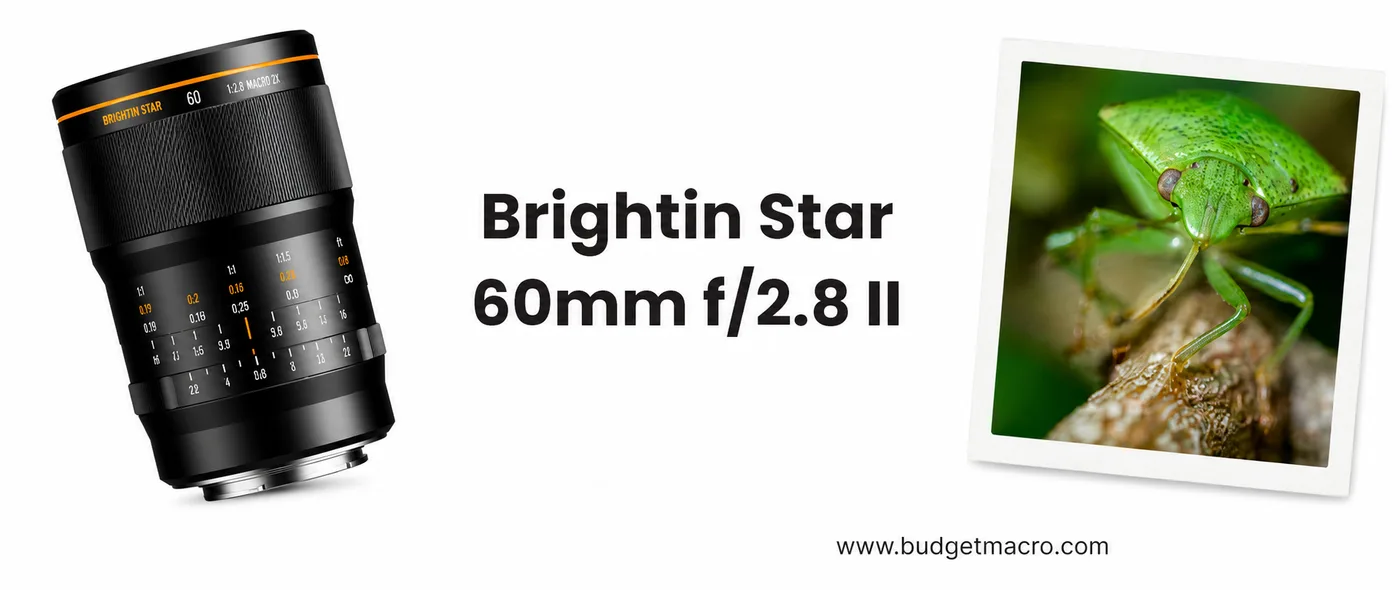
The focus ring is wide, well-damped, and offers about 160° of travel — long enough that you can dial in fine focus at 2:1, which you’ll absolutely need. Markings include focus distance in meters/feet and magnification ratios from 1:2 up to 2:1, which is genuinely useful.
The catch is the de-clicked aperture ring. It’s silky-smooth (which video shooters will love), but as Waldron notes, “for photography, it might be difficult to set the same aperture consistently.” Phillip Reeve’s Martin M.H. had the same complaint about the Pergear twin: “I happened to move the aperture while using it without being aware. Part of the pictures were taken with a different aperture than what I had intended to.” Worth taping the ring down if you’re shooting outside in the field.
Note: There’s a brand-new January 2026 “MF 60mm f/2.8” version from Brightin Star with a clicked aperture and slightly different specs (per PetaPixel). The lens in this review is the longstanding “60mm f/2.8 II” with the de-clicked ring, which is the version currently selling for ~$156–$170. If aperture clicks matter to you, check carefully which version you’re buying.
Optical Performance — Excellent at Macro, Shaky Everywhere Else
Here’s the honest breakdown, drawing on Martin M.H.’s detailed phillipreeve.net tests of the optically identical Pergear MK2:
- At 2:1 magnification: Sharpness wide open at f/2.8 is better than at 1:1, peaking at an excellent level by f/5.6. f/8 starts to soften from diffraction but is still very good, f/11 still good, f/16 usable, f/22 soft.
- At 1:1 magnification: “Very good at f/2.8, though it softens slightly at f/4 while remaining quite good.” Stop down to f/5.6–f/8 for the sweet spot.
- Center vs. edge: Center sharpness is the strong suit. Corners at infinity are soft until about f/11 on APS-C; on full-frame at non-macro distances, corners are basically unusable.
- Chromatic aberration: Genuinely well-controlled thanks to those ED elements — Martin M.H.’s tests show “no LoCA or LaCA visible.” Newsshooter’s Matthew Allard confirms it “doesn’t exhibit any real-world signs of chromatic aberration.”
- Bokeh: At close distances (between 1:2 and 2:1), bokeh is “super soft and almost nothing is recognisable in the background.” The 10-blade aperture gives nicely rounded specular highlights.
- Vignetting: This is the lens’s big asterisk. On APS-C, it’s a non-issue. On full-frame at infinity, phillipreeve.net measured a savage 4.1 EV of vignetting at f/2.8, and it gets worse when you stop down — because the front element has a rectangular cutout/mask that becomes visible when the optical block retreats from the front for distant focus. On APS-C the corners simply fall outside the frame.
- Distortion: Mild pincushion at normal distances on APS-C; roughly double that at macro distance. Easy to correct in Lightroom.
- Flare: This is the weakest area. Phillip Reeve: “The flare resistance is not good at all, avoid the sun in the frame or near edges and backlight shots.” Newsshooter: “the lens does not maintain particularly good contrast when a direct light source is aimed straight down the barrel.” No lens hood is included.
What It Feels Like to Actually Shoot
If you’ve never used a manual 2:1 macro lens before, the experience is a little humbling. Depth of field is microscopic, your subject is extremely close to the front of the lens, and any breeze becomes your mortal enemy.
But this isn’t really a Brightin Star problem. It’s a 2:1 macro problem.
In practice, most photographers will set the lens near the magnification they want and then focus by moving the whole camera back and forth. If your camera has focus peaking or magnified live view, use both. If it has in-body image stabilization, enable it and set the focal length manually to 60mm.
This is also one of those lenses that rewards extra lighting almost immediately. A cheap LED panel, a small flash with diffuser, or a budget twin-light setup will improve your keeper rate far more than obsessing over whether the optics are 5% better or worse than a Laowa.
Full-Frame vs APS-C: The Important Caveat
This needs its own section because Brightin Star’s marketing can mislead buyers.
Yes, the lens can illuminate a full-frame sensor at macro distances. No, that does not mean it behaves like a normal full-frame 60mm lens.
At macro distances, especially near 1:1 and 2:1, coverage is good enough to use. At longer focusing distances, however, the vignetting becomes so extreme that most full-frame shooters will want to crop into APS-C mode or just avoid using the lens for general photography altogether.
So if you’re buying this for a Sony A7, Nikon Zf, Canon R8, or another full-frame mirrorless body, think of it as a specialist macro tool, not a dual-purpose portrait/macro lens.
If you’re on APS-C or Micro Four Thirds, this is much less of an issue. In fact, that’s where the lens makes the most sense.
The Alternatives That Actually Matter
The Brightin Star only looks good if you compare it to the right things.
- Laowa 65mm f/2.8 2x Ultra Macro APO — The obvious upgrade. Better optical consistency, much stronger reputation, APO correction, and fewer weird compromises. But it’s roughly 2.5 times the price.
- 7Artisans 60mm f/2.8 II Macro — Another budget manual macro option, often around the same price, but it only goes to 1:1. If true 2x magnification is the point, the Brightin Star wins.
- TTArtisan 40mm f/2.8 Macro — The TTArtisan is the absolute cheapest macro lens out there at $99 (or $94 on promo, per Alwin Kok’s hands-on), but it’s 1:1 only and the 40mm focal length gives you a brutally short working distance.
What the Community Is Saying
The Brightin Star/Pergear lens has flown a bit under the radar — there aren’t massive Reddit megathreads about it — but the takes that exist are remarkably consistent:
- Scott Waldron (PhotographyBanzai): “If you’re looking for a manual macro lens with built-in 2:1 magnification, this one is worth considering.” Notes the vignetting and de-clicked aperture as caveats.
- Martin M.H. (phillipreeve.net) on the Pergear twin: “This is a highly affordable macro lens, offering excellent value for money… Sharpness is impressive, rivaling more expensive competitors, with excellent chromatic aberration control.” Critical of flare resistance and full-frame claims.
- A. Cemal Ekin (PetaPixel / KeptLight): “The Pergear 60mm Macro Mark II can get very close to yield twice the life-size images. That comes at a slight cost of lower image quality if the aperture is stopped down to gain extra depth of field. The price is attractive at the $199 list price.” Found the rings stiff out of the box.
- Matthew Allard (Newsshooter): “It is nice and sharp and it doesn’t exhibit any real-world signs of chromatic aberration… all in all, it is a solid offering that provides good results for a very low price.”
- Fstoppers: “The Pergear 60mm 2x Macro lens delivers a ton of macro performance for such a low price. It’s certainly not without issues, with the ‘full frame’ claim needing much more explanation for buyers.”
- DPReview forum users discussing budget 2:1 options have largely been more familiar with 7Artisans and Meike, with one user saying flatly: “I’m unfamiliar with Pergear and Brightin Star” — which tells you something about how niche this still is in serious enthusiast circles.
- Verified Brightin Star buyer (Canon M200 user): “It is incredible value for the money, I would have rated this a PERFECT lens… the focus ring is smooth and objects pop into focus very quickly… It’s honestly way sharper than i thought it would be.”
Kyle Taggart (YouTube) ran a head-to-head between the Pergear (Brightin Star twin) and the 7Artisans 60mm for Sony a6000 users — worth watching if you’re cross-shopping the two.
The recurring themes across community impressions: build quality surprises people positively, macro image quality genuinely impresses given the price, the de-clicked aperture frustrates stills shooters, and anyone trying to use it as a normal 90mm-equivalent lens on full-frame comes away annoyed.
Verdict — Probably the Most BudgetMacro Product on the List
Look — this isn’t a lens you buy because it’s the best 2x macro. It’s a lens you buy because it’s the cheapest legitimate ticket into a world that was, until very recently, gatekept by lenses costing $400 and up. The fact that the optics are actually pretty good at macro distances? That’s a bonus the price tag doesn’t fully prepare you for.
The big trade-offs are real but acceptable for the price: no autofocus, no electronics, no EXIF, a de-clicked aperture ring that makes consistent stills tricky, weak flare resistance, and vignetting that effectively limits you to APS-C-or-cropped use beyond macro distances. If any of those are dealbreakers, save up for a Laowa.
But if you’re the kind of hobbyist who wants to point a lens at a beetle’s eye, a flower stamen, or a watch movement and see things you can’t see with your naked eyes — and you don’t want to spend $400 finding out whether macro is going to be your thing — this is exactly the lens to start with. It’s a budget tool that lets you do something that, three years ago, simply wasn’t possible at this price.
For a site called BudgetMacro, this lens isn’t just on the list. It might be the list.
Recommendations
If you’re new to macro: Start here. Pair it with a small LED ring light (or a cheap macro twin flash), use APS-C mode if you’re on full-frame, and prefocus by rocking the camera in and out rather than turning the focus ring — that’s the technique every macro shooter learns anyway. Budget roughly $200 total ($170 lens + $30 light) and you have a complete 2x macro setup. Pricing and affiliate links can go below.
If you already own a 1:1 macro lens: This is a cheap way to add 2x magnification to your kit without giving up your existing autofocus lens for general use. Treat the Brightin Star as a specialist tool you grab specifically when you want to go closer.
If you’re shooting live insects in the field: Honestly, look at a longer macro (90mm+) with autofocus instead — the working distance and skittish subjects will fight you. The Laowa 100mm 2x APO or a used Sigma 105mm Macro will serve you better.
Upgrade triggers — when to graduate from this lens:
- You’re consistently dissatisfied with the flare/contrast in backlit scenes -> step up to the Laowa 65mm APO ($399).
- You’re shooting live, mobile subjects -> step up to a 90–100mm macro with longer working distance.
- You’re shooting full-frame and constantly fighting vignetting -> step up to a native full-frame 2x macro (Laowa 58mm APO or 90mm CA-Dreamer).
- You’re earning money from macro work -> at that point, autofocus, weather sealing, and consistency are worth real money. Move up.
Best mount choices:
- Best fit overall: Fuji X-mount or Sony E-mount on an APS-C body (A6700, X-T5, ZV-E10) — the 60mm gives you a useful 90mm equivalent, and the lens’s APS-C image circle matches perfectly.
- Best for absolute magnification: Micro Four Thirds — the 2:1 native magnification becomes 4:1 equivalent framing, which is wild for tiny subjects.
- Trickiest: Canon EF-M — requires camera set to “Release without lens,” and EF-M is a dead-end system. Only buy this mount if you already own an M-series body.
Caveats
- Two slightly different versions exist as of early 2026. The longstanding “Brightin Star 60mm f/2.8 II 2x Macro” reviewed here has a de-clicked aperture ring. A newer “Brightin Star MF 60mm f/2.8 APS-C Macro” announced in January 2026 (per PetaPixel) reportedly has a clicked aperture ring and an MSRP of $179.99 (launch price $169.99). Confirm which version you’re buying before clicking.
- Listed weight and dimensions vary across sources — most place it at ~660g and 68×118mm, but some Canon-mount listings cite 698g and 73×112mm. Mount type may add small differences; treat published numbers as approximate.
- “Full-frame capable” is technically true but practically misleading. At non-macro focus distances on a full-frame sensor, vignetting is severe enough to render the lens unusable for general photography. Plan to shoot APS-C-cropped (or buy a different lens) if full-frame general use matters.
- Most published reviews are based on review samples provided by Brightin Star or Pergear. The reviewers I’ve quoted (PhotographyBanzai, phillipreeve.net, Newsshooter, PetaPixel) have all disclosed this. Independent forum/store impressions broadly back them up, but be aware.
- Sample variation is plausible with budget Chinese manual lenses. One prototype review on 35mmc.com noted a slightly off-centered red mount dot, and a verified Pergear buyer reported initial aperture-ring play that “cleared up.” If yours arrives obviously decentered or with loose rings, exchange it.
- The “minimum focusing distance” of 0.18m is measured from the sensor plane, not the front of the lens — at 2:1 magnification you’re working about 5 cm (2 inches) from the front element to your subject. Plan your lighting accordingly.
- No weather sealing, no IS, no lens hood included. Standard for the price, but worth knowing if you’re shooting outdoors in dewy mornings (when most of the good bug shots happen).